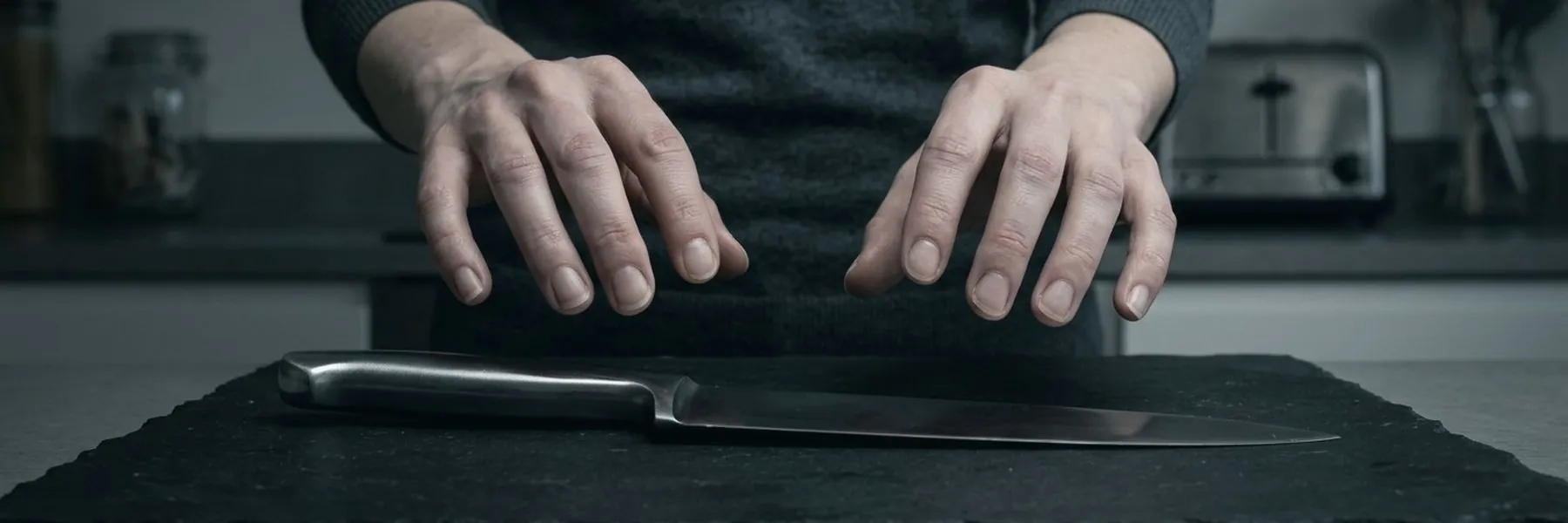
Harm OCD involves unwanted, intrusive thoughts, images or urges about causing harm: pushing someone in front of a train, hurting a child, swerving into traffic, losing control with a knife in the kitchen. For the person having them, these thoughts are horrifying. They often lead to a frightening question: what if this means I'm dangerous?
It doesn't. This is one of the most common forms of OCD, and one of the least talked about, because the people who have it are often too ashamed or frightened to say the thoughts out loud. A close relative, moral OCD, turns the same doubt towards whether you are a good person; I describe it below.
Why these thoughts happen
Research on intrusive thoughts consistently finds that the great majority of people experience thoughts of harming someone at some point. Standing on a platform and briefly imagining jumping or pushing, or holding a baby and picturing dropping it, are ordinary experiences of a human mind.
Most people notice the thought, find it odd, and move on. In OCD, the thought gets treated as meaningful: as a warning, a hidden desire, or a sign of what you might do. That interpretation triggers intense anxiety, and the anxiety makes the thought stickier and more frequent.
Harm OCD tends to attach itself to the people and values that matter most. New parents have thoughts about harming their baby. Caring, gentle people have thoughts about violence. That is not a coincidence. The thought causes such distress precisely because it goes against who you are.
A closely related form is often called paedophilia OCD, or POCD. It involves unwanted thoughts or images of a sexual nature about children, and the fear that they reveal something about you. It works in exactly the same way: the thoughts are horrifying because they go against everything the person values, and they lead to the same avoidance, checking and reassurance seeking, including anxiously checking the body for any sign of a reaction. POCD is treated in the same way as harm OCD.
Harm OCD and moral OCD
Moral OCD, sometimes called moral scrupulosity, is a close relative. Here the fear is less about being dangerous and more about being a bad person. Did I just lie? Was I unfair to that colleague? Did I cheat without realising it? Am I secretly selfish, cruel or dishonest? People with moral OCD usually hold unusually high standards of honesty and fairness, which is exactly why the doubt hurts so much.
It works in the same way as harm OCD. A doubt about your character feels urgent, and you try to settle it: replaying conversations, going over your motives, confessing small things, apologising repeatedly, or asking others whether you did something wrong. The relief never lasts, because complete certainty about your own goodness is not available to anyone. When the doubts are about sin or religious rules, this is often called religious scrupulosity, and it works in the same way too.
Moral OCD is treated in the same way as harm OCD, which I describe below.
What people with harm OCD tend to do
Because the thoughts feel so dangerous, people understandably try to protect themselves and others. Common responses include:
- Avoiding knives, sharp objects, driving, or being alone with children or vulnerable people
- Checking: reviewing whether something happened, looking back in the car mirror, checking news reports
- Monitoring yourself for signs of anger, urges or "enjoying" the thought
- Seeking reassurance that you're not dangerous, or confessing the thoughts
- Trying hard to push the thoughts away, or cancelling them with a "good" thought
All of these make sense, and all of them keep the problem going. Avoidance confirms that you couldn't be trusted in that situation. Monitoring finds ambiguous feelings and treats them as evidence. Suppression makes thoughts come back more often. Over time, life gets smaller: people stop cooking, stop driving, stop holding their children, and live with constant fear about themselves.
Is it OCD, or something else?
This is a question people with harm OCD often ask repeatedly, and asking it can itself become a compulsion. A careful clinical assessment considers it properly, once. Typical features of harm OCD include finding the thoughts horrifying and unwanted, going to great lengths to avoid acting on them, and having no wish or intention to cause harm. That pattern is very different from someone who has thoughts of harm that feel acceptable or wanted.
If you are reading this and feeling relieved, and then immediately doubting whether the description really applies to you, that pattern is very characteristic of OCD. The need to be completely sure is at the heart of the problem, which I explain in OCD and intolerance of uncertainty.
How harm OCD is treated
Harm OCD is treated with the same approach as other forms of OCD: CBT with exposure and response prevention. Treatment does not involve putting anyone at risk. It involves gradually returning to the parts of life the OCD has taken away, at a pace agreed together, and loosening the hold of the beliefs that give the thoughts their power: that having a thought means you want it, that thinking something makes it more likely, and that you are responsible for preventing any possible harm.
Much of the work involves gradually changing the protective habits the OCD relies on, at a pace we agree. The aim is something more durable than reassurance: a life in which the thoughts no longer dictate what you do. For more on this, see Why reassurance keeps OCD going.
Harm OCD is very treatable, and people are often surprised by how much changes once they are working with someone who recognises exactly what is happening.
In my practice
People with harm OCD often tell me they have never said their thoughts aloud to anyone. Being able to describe them to someone who recognises exactly what they are, and isn't alarmed, is often the first real relief. From there, treatment is practical and structured. You can read more about how I work on my page about OCD therapy with ERP in London and online.
If any of this sounds familiar, you may find it useful to talk it through. I offer an initial assessment, online or in person in Queen's Park, and can tell you honestly whether I think treatment with me is the right fit.
Book a free consultation
BABCP-accredited CBT therapist and EMDR Europe accredited practitioner, in clinical practice since 2015. Guy works with adults online and in Queen's Park, North West London, with a particular focus on OCD, anxiety and trauma. More about Guy